
by Kathleen Lynch | Nov 24, 2015 | IP Management
There was an interesting article yesterday in the Wall Street Journal about patent demand letters. These are letters sent alleging patent infringement and demanding a cessation in all infringing activity usually followed by a request for a payment. The author, Colleen Chien, proposes that sometimes the best thing to do is nothing at all.
The article discusses the tactics of patent trolls, competitors and “patent bullies” and how they may strategically pursue one or more parties for infringement. In some cases, where a patent troll or patent owner trying to test the waters may send out demand letters to obtain settlements from a number of parties. However, Ms. Chien also points out that there are times that a patent holder may want to litigate in an effort to obtain a large damage award in a jury trial.
One thing Ms. Chien doesn’t address is the merits of the demand letter. When you receive a letter alleging patent infringement, do the allegations have any merit? A “do nothing” response may set you up for a patent infringement suit that may have been avoidable.
What’s the take away here? You are better off having a patent demand letter reviewed by patent counsel to address the merits of the accusation. Then you can make an informed decision as to whether the substantive allegations in the letter deserve a response.
Protecting your innovative developments is critical to any organization. Having the right person to help you make that decision is important. The Law Office of Kathleen Lynch PLLC is designed to help businesses such as yours keep ahead of the game. The first telephone consultation is free. Email us at kl****@*****aw.com.

by Kathleen Lynch | Oct 27, 2015 | IP Management
A recent court case showed that one San Francisco florist went too far in trying to protect the business. Farmgirl Flowers began selling flower arrangements in used coffee sacks made of burlap cloth. They promote the reuse of the burlap sacks and have a trademark registration for “Burlap Wrapped Bouquet” for cut flowers and live flower arrangements.
Another florist, Bloom That, began wrapping its flowers in burlap and while imitation is the best form of flattery, Farmgirl brought an action against the competition to try to stop it. Farmgirl claimed that the burlap coffee sacks were a form of trade dress.
The court disagreed. The court determined that the burlap was primarily functional in nature and thus could not constitute trade dress. The court found that burlap is durable, eco-friendly and had been the subject of a patent directed to wrapping flowers (US Pat. 5,706,629).
So what’s the take away here? While not succeeding in obtaining a trade dress registration on burlap per se, Farmgirl Flowers is succeeding in building brand awareness by using a different packaging approach. Farmgirl was not able to successfully prevent Bloom That from using burlap as a flower wrapper, but it is succeeding in building recognition by its customers and by promoting it on its website.
If you sell a product, think about ways that you can distinguish your product from the competition. Here the burlap coffee sacks were a relatively unique way of packaging flowers. In your business, think of ways using color, design, materials, sounds, scents, to establish a consistent manner of presentation for a product or line of products that will be memorable to consumers. Over time it will likely pay off.
Protecting your innovative developments is critical to any organization. Having the right person to help you make that decision is important. The Law Office of Kathleen Lynch PLLC is designed to help businesses such as yours keep ahead of the game. The first telephone consultation is free. Email us at kl****@*****aw.com.

by Kathleen Lynch | Oct 14, 2015 | IP Management
The Sixth Circuit Court of Appeals recently ruled that cheer leading uniforms may be subject to copyright protection. In particular, in Varsity Brands vs. Star Athletica, the court overruled a district court’s holding that the Varsity Brand uniforms were not separable from the utilitarian aspects of the uniform and thus not eligible for copyright protection.
The appellate court found that the design aspects of a cheer leading uniform can exist independently from the utilitarian ones. The court found that Varsity’s designers “arrange various graphic elements, including stripes, lines, chevrons, angles, curves, coloring, and shapes.” Id. at 28. The court concluded that the arrangement of design aspects to be totally separable from the garment’s functional aspects, namely “ to cover the body, permit free movement, and wick moisture.”
What is the take away here? Well for the fashion industry, this is good news. The appellate court is recognizing the separation of the functional aspects of a garment from the design elements. If that can be shown in this case, Varsity Brands may prevail on its copyright infringement claims against Star Athletica and companies moving forward may obtain copyright protection for their garments.
Protecting your innovative developments is critical to any organization. Having the right person to help you make that decision is important. The Law Office of Kathleen Lynch PLLC is designed to help businesses such as yours keep ahead of the game. The first telephone consultation is free. Email us at kl****@*****aw.com.
by Kathleen Lynch | Sep 29, 2015 | IP Management
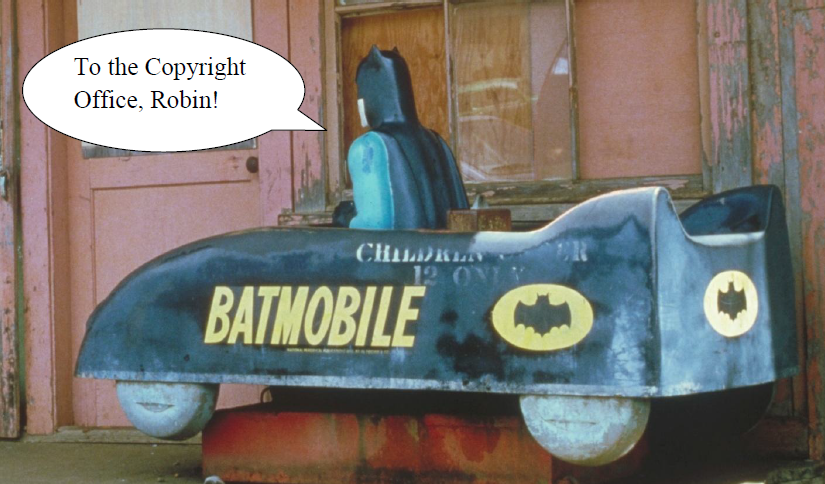
It is now settled: the Batmobile is subject to copyright protection. In a recent appellate court decision, the Batmobile was determined to have sufficient distinguishing features to entitle it to copyright protection.
The appeal was the result of a case brought by DC Comics against the owner of a garage in Los Angeles specializing in selling Batmobile replicas. DC Comics alleged that the garage committed copyright infringement when it sold cars that looked like the car in the 1966 television show and in the 1989 movie.
The court agreed. To find whether a character in a comic book, TV or movie is entitled to copyright protection, it must be shown that: (1) that the character has “physical as well as conceptual qualities”; (2) the character must be recognizable to people over time; and (3) the character is “especially distinctive”. The Batmobile passed the court’s test and DC Comics succeeded in stopping the sale of Batmobile replicas.
What’s the take away here? Think outside the box about how to best protect your intellectual property. While the Batmobile may not be considered under conventional standards as a “character”, the court found it was, and its shape and likeness are now subject to protection under copyright law.
Protecting your innovative developments is critical to any organization. Having the right person to help you make that decision is important. The Law Office of Kathleen Lynch PLLC is designed to help businesses such as yours keep ahead of the game. The first telephone consultation is free. Email us at kl****@*****aw.com.

by Kathleen Lynch | Sep 15, 2015 | IP Management, Patent Prosecution
The other day I was speaking to a business owner. She regretted not seeking patent protection sooner and more often for various innovations developed by her company. When we discussed average costs, she was surprised that the costs were considerably lower than what she thought they would be.
Provisional patent preparation and filing costs will depend on the approach you take to filing. There are basically two approaches to provisional patent filing. The first is the “cheap and cheerful” approach that requires that basic structure and function of the invention be communicated in the application with appropriate drawings, photos, and/or data or other relevant information.
The second provisional filing approach is to treat the provisional the same as a utility application. This means that the application will be written in a more formal, structured style as required for utility applications, including a set of claims, formal drawings, etc. The cheap and cheerful application can be free if you file it yourself. The US Patent and Trademark Office website has an inventor assistance center that provides basic information and help with filling out patent filing forms. Costs for provisional applications range from free if you do it yourself to an average of $4000, according to the American Intellectual Property Law Association (AIPLA). I think this figure is high and would recommend shopping around. See my previous post on selecting the right patent attorney for your invention.
Regular utility applications will cost more because they are more formal in nature and require drawings that comply with the U.S. Patent Office rules. However, if you go the more formal route first and file your provisional application as if it were a utility, then you only incur the cost once, except for additions and/or changes. Memories fade and attentions turn to other priorities. I believe the best approach is to prepare your provisional one time. In the long run, if there are few additions or changes, the cost is less than doing it twice. The average cost of a utility application is $7000 according to the AIPLA. Again, I would get more than one estimate and look at smaller firms and locations in areas where the cost of living is less.
At the end of the day, if you are self financing, it is still a significant spend. However, if your patentable innovation is at the core of your business, you can’t afford not to seek protection.
What’s the take away here? Don’t write off your ability to protect your invention with a patent before speaking to at least two or more patent professionals. Protecting your innovative developments is critical to any organization. Having the right person to help you make that decision is important. The Law Office of Kathleen Lynch PLLC is designed to help businesses such as yours keep ahead of the game. The first telephone consultation is free. Email us at kl****@*****aw.com.

by Kathleen Lynch | Sep 9, 2015 | IP Management
Southwest Energy Company recently found itself in the cross hairs of a trade secret dispute. It seems that a pair of geologists and an engineer created a detailed study of the drilling and fracing opportunities in East Texas. The team had identified 10 “sweet spots” for development and had begun leasing the targeted acreage so that a plan ready for drilling could be supplied to the highest bidder.
Apparently, Southwest Energy met with the trio and signed a confidentiality agreement. After reviewing the information and the proposal, Southwest declined to purchase the drill-ready plan. However, a year later, Southwest Energy purchased large amounts of acreage in and around the identified “sweet spots.” The geologists and engineer found this too coincidental and brought an action for theft of trade secrets.
A Texas court agreed with the trio and awarded a judgment of 40.2 million dollars. On appeal, the judgment was reduced to 11.4 million for lost profits. The case is currently pending before the Texas Supreme Court.
What’s the take away here? Regardless of your industry-protect your confidential information. It may be a supplier list, a pricing structure, or a manufacturing technique. Use the tools available to maintain these company secrets. Whether it is in the form of a confidentiality agreement, restricting physical access within your site, or conducting periodic training sessions to remind employees of the value of certain information, keep ahead of any potential leak. Once a trade secret has been disclosed, you cannot get it back.
Protecting proprietary information is critical to any organization. Having the right person to help you make those decisions is important. The Law Office of Kathleen Lynch PLLC is designed to help businesses such as yours keep ahead of the game. The first telephone consultation is free. Email us at kl****@*****aw.com.