
by Kathleen Lynch | Mar 22, 2016 | Entrepreneurship, Start Up Considerations
Paul McCartney is using a US Copyright provision to right a wrong he feels occurred many years ago. As you may recall, the bulk of the Beatles tunes were attributed to the duo of John Lennon and Paul McCartney. However, in the 1960’s, Paul McCartney and the other Beatles lost their publishing rights to many of their songs when ATV, a publishing company created by the Beatles, their manager and some of their investors, was sold without the knowledge of the band members.
At one time Yoko Ono, John Lennon’s widow and McCartney tried to purchase ATV for 20 million dollars. The deal fell through and Michael Jackson purchased ATV for 47.5 million in 1985. McCartney may now be able to reclaim those rights 56 years later.
Rather than let it be, McCartney filed a “notice of termination” with the US Copyright Office. This enables a songwriter to reclaim ownership in publishing rights for a song anywhere between 2 to 10 years before the 56 year lapse of time after the publication rights were originally sold. Some of the songs won’t be eligible for release until the singer is 83.
What’s the take away here. Any artist, author or creator of a work protected under copyright law should understand those rights . In addition, anyone who may have an interest subject to copyright law should think carefully about corporate structure and where the ownership of the intellectual property should be held when forming a new business. This often takes the form of an IP holding company. Situations may vary, but who will own the rights in the copyright and how the business will be structured should be well thought out when setting up any business.
Protecting your innovative developments is critical to any organization. Having the right person to help you make that decision is important. The Law Office of Kathleen Lynch PLLC is designed to help businesses such as yours keep ahead of the game. The first telephone consultation is free. Email us at [email protected].

by Kathleen Lynch | Oct 14, 2015 | IP Management
The Sixth Circuit Court of Appeals recently ruled that cheer leading uniforms may be subject to copyright protection. In particular, in Varsity Brands vs. Star Athletica, the court overruled a district court’s holding that the Varsity Brand uniforms were not separable from the utilitarian aspects of the uniform and thus not eligible for copyright protection.
The appellate court found that the design aspects of a cheer leading uniform can exist independently from the utilitarian ones. The court found that Varsity’s designers “arrange various graphic elements, including stripes, lines, chevrons, angles, curves, coloring, and shapes.” Id. at 28. The court concluded that the arrangement of design aspects to be totally separable from the garment’s functional aspects, namely “ to cover the body, permit free movement, and wick moisture.”
What is the take away here? Well for the fashion industry, this is good news. The appellate court is recognizing the separation of the functional aspects of a garment from the design elements. If that can be shown in this case, Varsity Brands may prevail on its copyright infringement claims against Star Athletica and companies moving forward may obtain copyright protection for their garments.
Protecting your innovative developments is critical to any organization. Having the right person to help you make that decision is important. The Law Office of Kathleen Lynch PLLC is designed to help businesses such as yours keep ahead of the game. The first telephone consultation is free. Email us at [email protected].
by Kathleen Lynch | Sep 29, 2015 | IP Management
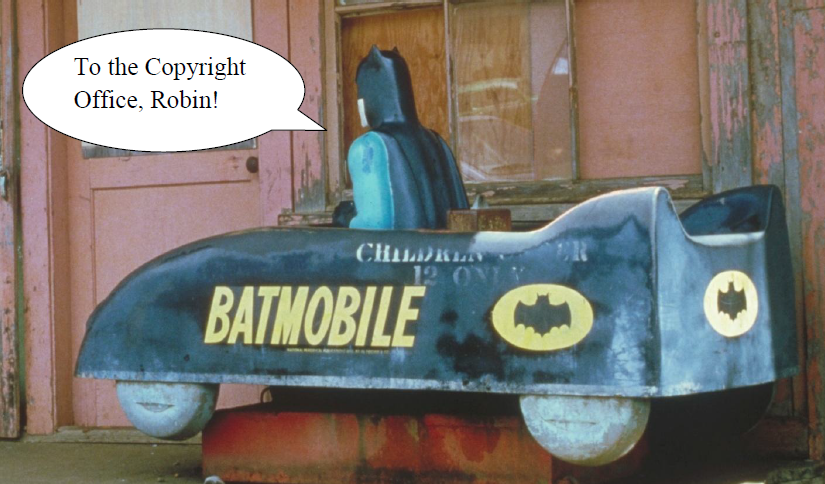
It is now settled: the Batmobile is subject to copyright protection. In a recent appellate court decision, the Batmobile was determined to have sufficient distinguishing features to entitle it to copyright protection.
The appeal was the result of a case brought by DC Comics against the owner of a garage in Los Angeles specializing in selling Batmobile replicas. DC Comics alleged that the garage committed copyright infringement when it sold cars that looked like the car in the 1966 television show and in the 1989 movie.
The court agreed. To find whether a character in a comic book, TV or movie is entitled to copyright protection, it must be shown that: (1) that the character has “physical as well as conceptual qualities”; (2) the character must be recognizable to people over time; and (3) the character is “especially distinctive”. The Batmobile passed the court’s test and DC Comics succeeded in stopping the sale of Batmobile replicas.
What’s the take away here? Think outside the box about how to best protect your intellectual property. While the Batmobile may not be considered under conventional standards as a “character”, the court found it was, and its shape and likeness are now subject to protection under copyright law.
Protecting your innovative developments is critical to any organization. Having the right person to help you make that decision is important. The Law Office of Kathleen Lynch PLLC is designed to help businesses such as yours keep ahead of the game. The first telephone consultation is free. Email us at [email protected].

by Kathleen Lynch | Aug 11, 2015 | Entrepreneurship, Innovation, Start Up Considerations
Joseph Tierney, is a well known street artist known as “Rime”. He sued fashion designer, Jeremy Scott and high-end Italian apparel brand, Moschino over the dress Katy Perry wore to the Metropolitan Museum of Art’s Met Gala in May.
Rime accused Moschino and Scott of copying one his giant murals entitled “Vandal Eyes,” which is now located on the side of a Detroit building, and displaying the mural on Perry’s dress. The name and signature of Rime were also on the dress. The dress and mural can be seen here.
Rime is bringing copyright, unfair competition and publicity rights claims against Moschino and Scott.
Rime states that the dress, which violated his rights, was also worn by supermodel Gigi Hadid at a the February 2015 Moschino runway show in Milan. In addition, photos of the dress are on the company’s websites as well as social media. Court documents reference The Wall Street Journal as reporting Moschino experienced a 16 percent increase in revenue for the first quarter of 2015.
Rime is asking the court to stop any further marketing or sale of the dresses as well as all profits made from the sale or any dresses, and other monetary damages.
What’s the take away here? Don’t copy someone else’s material. If you find something you like, ask if you can use it. If you cannot, create something yourself or go elsewhere.
Protecting your innovative developments is critical to any organization. Having the right person to help you make that decision is important. The Law Office of Kathleen Lynch PLLC is designed to help businesses such as yours keep ahead of the game. The first telephone consultation is free. Email us at [email protected].

by Kathleen Lynch | May 20, 2015 | Copyright
The internet today makes finding interesting content and artistic images easy. For anyone who has a presentation or a paper to write, finding the right information and/or images can mean the difference between success and failure. But before you hit the “download” button, consider the intellectual property implications.
Electronically available content, whether it is written or an image, is initially owned by its creator. The creator, such as an employee, may be under an obligation to assign rights in the creation to their employer. Anyone who uses content without authorization may be guilty of copyright infringement.
There are software programs available to track the use of electronic content. If the content is used without authorization by the owner, the user may be notified of their unauthorized use and asked to pay a fine and to stop any further use.
This happened to a client of mine. They used a photo their website developer “found” on the internet and posted it onto their business website. They did not seek authorization to use it and the owner of the photo sought damages, which they had to pay.
So, the next time you want to cut and paste, remember that someone else may be the creator of some of your content. Don’t download what you don’t own until you have permission. If you don’t obtain permission, respect the copyright.
Identifying, protecting and leveraging intellectual property is critical to any organization. Having the right person to help you make those decisions is important. The Law Office of Kathleen Lynch PLLC is designed to help businesses such as yours keep ahead of the game. The first telephone consultation is free. Email us at [email protected].