by Kathleen Lynch | Apr 16, 2015 | Patent
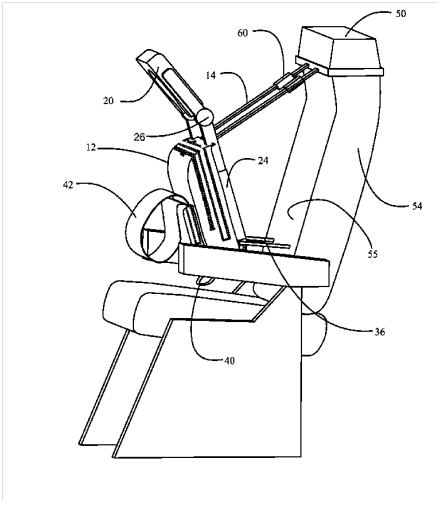
Boeing received an issued U.S. patent recently on a device that makes it easier for passengers to sleep on an airplane. The patent (U.S. 8,985,693) entitled, “Transport Vehicle Upright Sleep Support System”, consists of a backpack device that is removed and placed around the structure of a standard economy (cattle) class seat. The device is designed to enable a passenger to face plant themselves into a support cushion that will enable them to sleep essentially sitting up and leaning forward. The face support cushion has an opening around the face so that you don’t feel entirely smothered. The device also has sleeves to support the passenger’s arms.
The device is designed to be used on an existing standard coach class seat. You may be able to sleep better leaning forward than the traditional pose of reclining backward. According to the patent, when trying to sleep in a reclined position, there is a natural tendency to relax the body’s muscles and move into a more horizontal position which awakens the body.
Now, if they could only do something about the space in coach class…!
Capitalizing on innovative developments is critical to any organization. Having the right person to help you make those decisions is important. The Law Office of Kathleen Lynch PLLC is designed to help businesses such as yours keep ahead of the game. The first telephone consultation is free. Email us at kl****@*****aw.com.

by Kathleen Lynch | Feb 17, 2015 | Patent
The new inter partes review procedures were reviewed for the first time by the Federal Circuit Court of Appeals recently. The court in a 2 to 1 decision, the Court upheld the Patent Office standard of review used by the Patent Office to invalidate patents.
Effective in September 2012, the new inter partes review procedure is an administrative process authorized under the America Invents Act. It provides a third party with the opportunity to dispute the validity of a recently issued patent before the US Patent Office.
Many are calling the new procedures a “death squad” to patents because these new procedures give the Patent Office broad authority to invalidate patents. The procedures are quickly being adopted by many companies to invalidate a competitor’s patent.
The process is an administrative one. As such, the process is relatively inexpensive and quicker than federal litigation. The procedures to date have invalidated more patents than the amount invalidated through the federal court system during the same time period.
Take away
keep an eye out for recently issued patents in your area of technology to determine whether the new inter partes review process might be an appropriate avenue for your company to pursue. Conversely, once your patent issues, you need to be aware of this procedure from a defensive standpoint as well.
Capitalizing on innovative developments is critical to any organization. Having the right person to help you make those decisions is important. The Law Office of Kathleen Lynch PLLC is designed to help businesses such as yours keep ahead of the game. The first telephone consultation is free. Email us at kl****@*****aw.com.
by Kathleen Lynch | Feb 3, 2015 | Innovation, Patent, Trade Secrets
Unitherm Food Systems, a food process machinery manufacturer, recently discovered that you cannot seek both patent and trade secret protection for the same innovation. Unitherm filed an action in 2014 against Hormel for disclosing Unitherm’s trade secrets to a competitor. Unitherm’s alleged trade secret focused on a method for pre-cooking sliced bacon.
In 2007, both companies executed a joint development agreement for developing an oven that would produce high levels of steam for cooking. Under the agreement, Hormel would own all intellectual property. In 2008 Unitherm filed a patent application covering the process of cooking food at high steam levels. Hormel withdrew from the agreement with Unitherm and filed for patent protection in 2010 on its own method of cooking bacon. Unitherm alleged that the method claimed by Hormel was that developed by Unitherm during the course of the joint development agreement and was proprietary.
The court threw out Unitherm’s claim for misappropriating its trade secret. The judge told Unitherm that they could not maintain a trade secret on something for which they were seeking patent protection.
Take away: you can’t claim something as a trade secret if you are going to try to obtain patent protection for the same innovation. Best practice: first figure out what is the best avenue for protection for your innovation (i.e. patent, design patent, trade secret, etc.). Then, try to obtain that protection for your innovation to the greatest extent allowed by law.
Protecting your innovative developments is critical to any organization. Having the right person to help you make that decision is important. The Law Office of Kathleen Lynch PLLC is designed to help businesses such as yours keep ahead of the game. The first telephone consultation is free. Email us at kl****@*****aw.com.
by Kathleen Lynch | Dec 16, 2014 | Invention, Patent, Pro Bono, US Patent Office
This week, I have the pleasure of interviewing Jennifer McDowell, Coordinator of the USPTO’s Patent Pro Bono Program. Jenny, along with others on the Pro Bono Team, are tasked with ensuring that the Patent Pro Bono Program is fully implemented in all 50 states and that qualifying inventors have access to patent pro bono services under the program.
Kathy: Jenny, what is the Patent Pro Bono Program?
Jenny: The Patent Pro Bono Program provides free legal assistance to inventors of modest means who are interested in securing patents to protect their inventions. The Program is a product of the America Invents Act (AIA), which was signed into law in 2011. Under this legislation the U.S. Patent and Trademark Office was called upon to begin working with intellectual property law associations across the country to establish programs to assist financially under-resourced independent inventors and small businesses. Then, in February 2014, the President issued an Executive Action calling for expansion of the pro bono programs originally set up under the AIA into all 50 states. As a result of the Executive Action, new pro bono programs have been created, and many of the existing programs have expanded their coverage to additional states.
Kathy: Who qualifies for help under the program?
Jenny: Each regional Patent Pro Bono program sets the criteria for an inventor’s acceptance into the program, based upon the local needs in the community, and oftentimes, in consultation with the state bar. Generally, though, most programs require that an inventor have: (1) income below 300% of the Federal poverty level; (2) knowledge of the patent system; and (3) the ability to describe his or her invention so that someone could make and use the invention. The income threshold is based on how many people are in the inventor’s household. Right now, the Federal poverty level for a one person household is $11,670, so 300% would be $35,010. Because each regional program is operated independently, inventors are strongly encouraged to contact their program directly, review their program’s website, or check out the USPTO’s website to learn about the eligibility criteria. The link for the USPTO’s pro bono webpage is: http://www.uspto.gov/inventors/proseprobono/.
Kathy: How does an inventor apply for help under the program?
Jenny: We strongly encourage inventors to apply directly to their regional program. A link to each regional program can be found under the heading of “Participating Patent Pro Bono Programs” on the USPTO’s website. Alternatively, an inventor may request assistance through the Federal Circuit’s National Clearinghouse Portal by filling out the Pro Bono Service Request Form. The Federal Circuit Bar Association will forward the inventor’s request to the appropriate regional program (for those states with current pro bono coverage).
Kathy: Is there a limit on the number of inventors that are accepted into the program each year?
Jenny: No. There is no limit on how many inventors may participate in the Patent Pro Bono Program. However, as a practical matter, for each inventor accepted into a regional program, there must be a volunteer patent attorney willing to represent him or her for the program to be successful.
Kathy: Does the program cover patent office filing fees?
Jenny: No, an inventor must pay for any USPTO filing fees. The Patent Pro Bono Program covers the attorneys’ fees associated with preparing, filing, and advancing a patent application through the USPTO to patent grant.
Kathy: Can an inventor be part of the pro bono program if his/her state is not listed as participating?
Jenny: Maybe. If an inventor lives in a state which is not currently covered by a Patent Pro Bono program, but meets the qualifications to request assistance from a program in a different state (e.g., the inventor lives and works in different states), then the inventor may apply to the program for which he or she qualifies. At the moment, some states have agreed to work with neighboring states to administer the program for those states. For example, the North Carolina Bar Association Inventor Assistance Program has agreed to administer the program for Tennessee and South Carolina. Similarly, the California program currently provides pro bono coverage for the states of California, Alaska, Hawaii, Nevada, Arizona, Oregon, Washington, Montana, and Idaho. If the inventor is not able to qualify for a program in a different state, the inventor should continue to monitor the USPTO’s pro bono web page because new programs are opening on a regular basis.
Kathy: When does the USPTO expect nationwide coverage to be available for the Patent Pro Bono Program?
Jenny: We are targeting to have pro bono programs in place nationwide by the end of 2015. Pro se inventors are an important component of the patent community, and we are eager to enable them to receive the legal help they need to protect their inventions as quickly as possible.
Kathy: How can patent attorneys volunteer to help pro se inventors through this program?
Jenny: Any registered patent attorney who wishes to volunteer in a regional Patent Pro Bono program can apply directly with their regional program. Most programs have a simple form that attorneys complete. Additionally, many programs provide training to their volunteer lawyers on how the inventor assistance program works for their region. Also, an attorney can sign up at the Federal Circuit’s National Clearinghouse Portal by filling out the Regional Volunteer Attorney Submission Form.
Kathy: How can local businesses support this program?
Jenny: Local business can contact the regional program in their area and speak with the program’s director or administrator. They will be able to give businesses valuable and specific information about ways that their particular program could best use the help of businesses.
Kathy: Do you anticipate getting all 50 states involved in this program soon?
Jenny: Absolutely! We are working very hard with various groups to secure nationwide coverage as soon as possible. We’ve made tremendous progress so far. On November 18, 2014, the Michigan program opened its doors. Soon, the Georgia program will be opening as well. Likewise, in short order, the New York and Massachusetts programs will be expanding to cover every state in the northeast corridor. The USPTO’s website will keep everyone updated in real time.
Kathy: Are there examples that you can point to where this program has helped a local business or the local economy?
Jenny: Of course. The positive economic impact of the Patent Pro Bono Program is one of the fundamental reasons that the USPTO is so committed to growing the Program and making it available in all 50 states. Keep in mind, the amount of time from the filing of a patent application to issuance of the patent can be substantial, and the first AIA Patent Pro Bono Program only began in late 2011. Still, several inventions have been patented through the regional programs. As just one example, in 2011, Travis Kelley, a pro se inventor in Backus, Minnesota, sought legal help through the Minnesota Pro Bono Program to patent his door leveler and spacer kit invention. He was matched with a LegalCORPS volunteer patent lawyer, and by March 2014, he received a patent (U.S. Patent No. 8,677,636). His company, JenTra Tools, has manufactured over 6,000 units so far, grossing over $150,000 in revenue, and has hired three employees in Minnesota. What’s more, JenTra Tools hopes to save the entire door manufacturing industry both time and money with his device, since it prevents improper door installation. That’s money infused into the local economy and cost savings that will make the American economy more competitive.
Kathy: Are there any efforts to target women, minority, or veteran entrepreneurs?
Jenny: The USPTO wants as many people to know about the Patent Pro Bono Program as possible, including women, minority, and veteran entrepreneurs. In this regard, the USPTO is working closely with intellectual property organizations to publicize the programs at various events targeting many of these groups. If there is a special need in a particular community for additional information, requests can be sent to Pa***********@***to.gov.
Kathy: After there is nationwide coverage for the pro bono program, what’s next for the Patent Pro Bono Program?
Jenny: After the USPTO helps to establish pro bono programs across the country, we have several ideas for next steps. First, we are looking forward to developing metrics to measure the use and success of the programs. We also want to find ways of recognizing volunteer attorneys for their contributions to the patent system by giving free legal aid to pro se inventors. Lastly, we aim to publicize the programs, both for inventors and volunteer attorneys, in order to grow the programs. On that score, we appreciate this very opportunity to promote the Patent Pro Bono Program and thank you for selecting this topic for a blog.
The Law Office of Kathleen Lynch PLLC is designed to help entrepreneurs and small businesses protect their intellectual property. The first telephone consultation is free. Email us at kl****@*****aw.com.

by Kathleen Lynch | Oct 28, 2014 | Patent, US Patent Office
Last week I was vindicated to some extent by Good Morning America. Lori Greiner from the show “Shark Tank” provided some advice to the morning’s “tank” contestants. First thing she said was: “get a good IP attorney.” At the risk of sounding self-promotional, this is so important. I’ve posted before on how to select a good IP attorney. The things I think are most important are experience, expertise and relationship.
Here are a few questions to ask a potential IP attorney:
Does s/he practice patent law?
If you are interested in protecting an article or method of manufacture, you should seek out the advice of a patent attorney. Only patent attorneys and patent agents practice before the US Patent Office. In order to practice before the US Patent and Trademark Office, an attorney or agent must pass the US Patent Bar. This requires the person to have a bachelor’s degree in a technical field such as science or engineering and pass the US Patent Bar examination. Those tasked with preparing and filing a patent application and communicating with the US Patent Office with regard to patents and patent applications, must take and pass the US Patent Bar.
How long has s/he been practicing patent law?
Like any profession, patent law requires a certain level of skill and expertise which comes from experience and work. Someone who has filed many patent applications and has helped to move numerous applications through to issued patents will have a greater level of experience than someone with few or no dealings with the Patent Office.
What is his/her area of expertise?
This is a critical area. You need to ask what is the patent attorney’s area of expertise. What did the attorney study in college and in what area of technology do they focus their patent practice? In the same way you wouldn’t want a dermatologist to conduct heart by-pass surgery on you or a loved one, you should not select an attorney with a biochemistry degree to file your patent application directed to electronics.
Finally, there is the relationship aspect of any interaction between attorney and client. Do you have confidence in this person? Do you trust this person to act in your best interest?
As Lori Greiner confirmed, selecting the right IP attorney is critical. The Law Office of Kathleen Lynch PLLC is designed to help businesses such as yours keep ahead of the game. The first telephone consultation is free. Email us at kl****@*****aw.com.
by Kathleen Lynch | Oct 7, 2014 | Infringement, Patent
This is the second in a series of posts on the basics of patents. The first post discussed the scope of a patent and how to obtain one. This post will focus on the benefits of a patent and how you can enforce one.
Now that you have a patent, what can it do for you? A patent is only as good as your ability to enforce it. A patent owner has the right to keep others from making, using, selling or offering for sale his/her patented invention. A patented invention is defined by its claims. The claims are the last part of the patent document and are numbered. The claims define the “metes and bounds” of the invention.
In a dispute, or when a patent is asserted against an alleged infringing party, the claims are interpreted to determine the scope of the invention. Once the scope of the invention is determined, then that scope is applied to the alleged infringing activity to see if it falls within the scope of the patented claims.
Patent infringement is a federal offense and may be brought in federal court. Patent infringement provides for the recovery of both actual and punitive damages. These may include up to three times the damages if the infringement is found to be willful or intentional. A patent owner may also seek an injunction to stop existing and future infringing activity. In some cases costs and attorneys fees are also recoverable.
Capitalizing on innovative developments is critical to any organization. Having the right person to help you make those decisions is important. The Law Office of Kathleen Lynch PLLC is designed to help businesses such as yours keep ahead of the game. The first telephone consultation is free. Email us at kl****@*****aw.com.