by Kathleen Lynch | Apr 1, 2016 | Patent Prosecution
Writing a patent application is always a challenge. In each case, it is a balance. On one side, you are trying to ensure that you have provided an accurate and complete description of the invention. On the other you worry about what the patent examiner might turn up in prior art that you didn’t think about when drafting the application. Sometimes what is included may come back to limit the scope of your invention.
This is exactly what happened to UltimatePointer LLC when they sued Ninentendo for patent infringement (UltimatePointer, LLC v. Nintendo Co., Ltd., No. 15-1297 (Fed. Cir. Mar. 1, 2016). The Federal Circuit, the appellate court for patent cases, affirmed a district court finding of noninfringement by Nintendo. The district court found the term “handheld device” to require a “direct pointing device”. The Federal Circuit found that UltimatePointer had made “repeated derogatory statements” relating to indirect pointing devices in the patent specification. The court stated that the “criticized technologies were not intended to be within the scope of the claims.” The court determined that Nintendo’s pointing involves the hand held remote relative to the sensor bar and not the television screen image. As a result, the court found the Wii system was considered an “indirect” pointing device and did not infringe.
What’s the take away here? Be careful what you write in your specification, especially in the area of describing other prior art. You never know what prior art you may encounter down the road and you need to keep as many options open as possible.
Protecting your innovative developments is critical to any organization. Having the right person to help you make that decision is important. The Law Office of Kathleen Lynch PLLC is designed to help businesses such as yours keep ahead of the game. The first telephone consultation is free. Email us at kl****@*****aw.com.

by Kathleen Lynch | Feb 23, 2016 | IP Management, Patent Prosecution
In Transweb LLC v. 3M Innovative Properties Company & 3M Company, the Federal Circuit Court of Appeals affirmed the district court’s finding that 3M was liable for antitrust violations in that 3M was found to have obtained its patent through inequitable conduct and subsequently sought to enforce the patent. As a result of 3Ms behavior in both acquiring and enforcing the patent, the appellate court awarded treble attorneys’ fees which came to about $26 million.
The patents at issue focus on filter material used in respirators for construction workers etc. Transweb had developed a new filter material similar to the 3M subject patents. The Federal Circuit found the 3M patents were invalid based on evidence indicating that Transweb’s president distributed samples of their new filter material at a trade show more than a year before 3M filed patent applications covering their new filter material. The finding of inequitable conduct was confirmed because the evidence indicated 3M knew of Transweb’s prior distribution, and did not properly disclose it to the US Patent and Trademark Office as required.
The court then found that 3M’s enforcement of their patent against Transweb constituted an antitrust violation as an abuse of the legal process and awarded Transweb’s attorneys’ fees for defending against 3M’s lawsuit. In justifying the award, the court stated that the attorneys fees were appropriate because they flowed directly from “3M’s unlawful act [of] bringing suit based on a patent known to be fraudulently obtained.” In awarding treble attorneys’ fees, the court indicated that the enhanced award was justified because the suit brought by 3M forced Transweb to either cease competition in the market or expend money to defend itself.
What’s the take away here? When preparing and prosecuting a patent application, ensure that your organization meets all requirements with regarding to disclosure to the US Patent Office. This requires diligence and educating all involved in the process. Sometimes that can include sales, marketing, and business development personnel as well as R&D and manufacturing.
Protecting your innovative developments is critical to any organization. Having the right person to help you make that decision is important. The Law Office of Kathleen Lynch PLLC is designed to help businesses such as yours keep ahead of the game. The first telephone consultation is free. Email us at kl****@*****aw.com.

by Kathleen Lynch | Feb 16, 2016 | Trademark Service Mark
If you want to be a superhero, you’re going to have to create your own logo. In a recent California court case, DC Comics v. Mad Engine, Inc., the court refused to dismiss an action brought by DC Comics against Mad Engine for trademark infringement. Mad Engine was selling t-shirts with a “dad” logo in red and yellow on a blue shirt. The logo was a five-sided shield similar is style to the Superman “S” that appears in DC Comics books and movies.
Mad Engine asked the court to dismiss the lawsuit on the basis that the “dad” logo was a parody of the Superman logo. The court rejected the argument and the case now moves on to trial.
What’s the take away here? Even if you think your mark is a parody of another mark. The owner of the other mark may not share your sense of humor. Think twice before proceeding with a mark like that.
Protecting your innovative developments is critical to any organization. Having the right person to help you make that decision is important. The Law Office of Kathleen Lynch PLLC is designed to help businesses such as yours keep ahead of the game. The first telephone consultation is free. Email us at kl****@*****aw.com.
As an aside, I’ll be speaking on Thursday, February 18th at the NC Bar Association Business Law Section Annual Meeting on a panel discussion of IP issues in Pinehurst NC. Anyone thinking of attending, I hope you do as it is shaping up to be an interesting program. I’ll also be there on behalf of NCLEAP (North Carolina Lawyer Entrepreneur’s Assistance Program) recruiting new volunteers. If you’re there, please come and say “hello”.

by Kathleen Lynch | Nov 24, 2015 | IP Management
There was an interesting article yesterday in the Wall Street Journal about patent demand letters. These are letters sent alleging patent infringement and demanding a cessation in all infringing activity usually followed by a request for a payment. The author, Colleen Chien, proposes that sometimes the best thing to do is nothing at all.
The article discusses the tactics of patent trolls, competitors and “patent bullies” and how they may strategically pursue one or more parties for infringement. In some cases, where a patent troll or patent owner trying to test the waters may send out demand letters to obtain settlements from a number of parties. However, Ms. Chien also points out that there are times that a patent holder may want to litigate in an effort to obtain a large damage award in a jury trial.
One thing Ms. Chien doesn’t address is the merits of the demand letter. When you receive a letter alleging patent infringement, do the allegations have any merit? A “do nothing” response may set you up for a patent infringement suit that may have been avoidable.
What’s the take away here? You are better off having a patent demand letter reviewed by patent counsel to address the merits of the accusation. Then you can make an informed decision as to whether the substantive allegations in the letter deserve a response.
Protecting your innovative developments is critical to any organization. Having the right person to help you make that decision is important. The Law Office of Kathleen Lynch PLLC is designed to help businesses such as yours keep ahead of the game. The first telephone consultation is free. Email us at kl****@*****aw.com.
by Kathleen Lynch | Sep 29, 2015 | IP Management
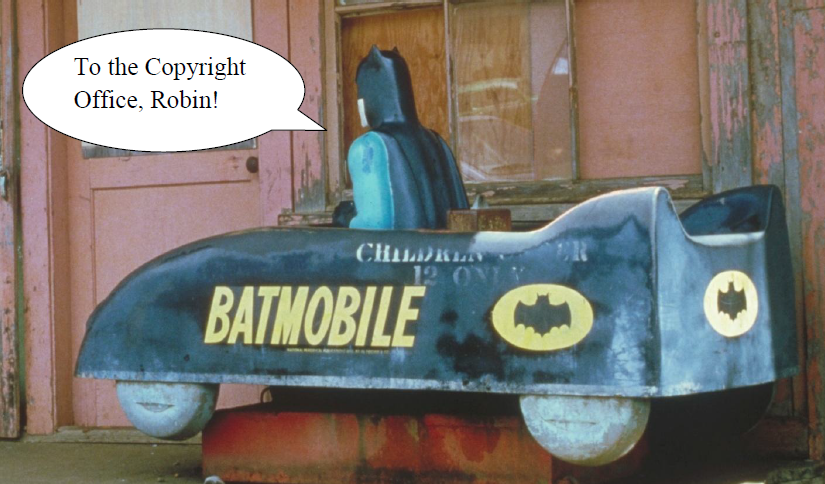
It is now settled: the Batmobile is subject to copyright protection. In a recent appellate court decision, the Batmobile was determined to have sufficient distinguishing features to entitle it to copyright protection.
The appeal was the result of a case brought by DC Comics against the owner of a garage in Los Angeles specializing in selling Batmobile replicas. DC Comics alleged that the garage committed copyright infringement when it sold cars that looked like the car in the 1966 television show and in the 1989 movie.
The court agreed. To find whether a character in a comic book, TV or movie is entitled to copyright protection, it must be shown that: (1) that the character has “physical as well as conceptual qualities”; (2) the character must be recognizable to people over time; and (3) the character is “especially distinctive”. The Batmobile passed the court’s test and DC Comics succeeded in stopping the sale of Batmobile replicas.
What’s the take away here? Think outside the box about how to best protect your intellectual property. While the Batmobile may not be considered under conventional standards as a “character”, the court found it was, and its shape and likeness are now subject to protection under copyright law.
Protecting your innovative developments is critical to any organization. Having the right person to help you make that decision is important. The Law Office of Kathleen Lynch PLLC is designed to help businesses such as yours keep ahead of the game. The first telephone consultation is free. Email us at kl****@*****aw.com.